

Save the Dates of Upcoming Webinars
Please save these dates for our upcoming webinars.
End of Life Care and Memory Making
Date: 18 November 2026
Time: 18h30 – 20h00
More information to follow. To keep updated on what is happening at PatchSA, consider signing up for our newsletters here.
Adolescent Palliative Care
Support, Communication & the Transition Journey
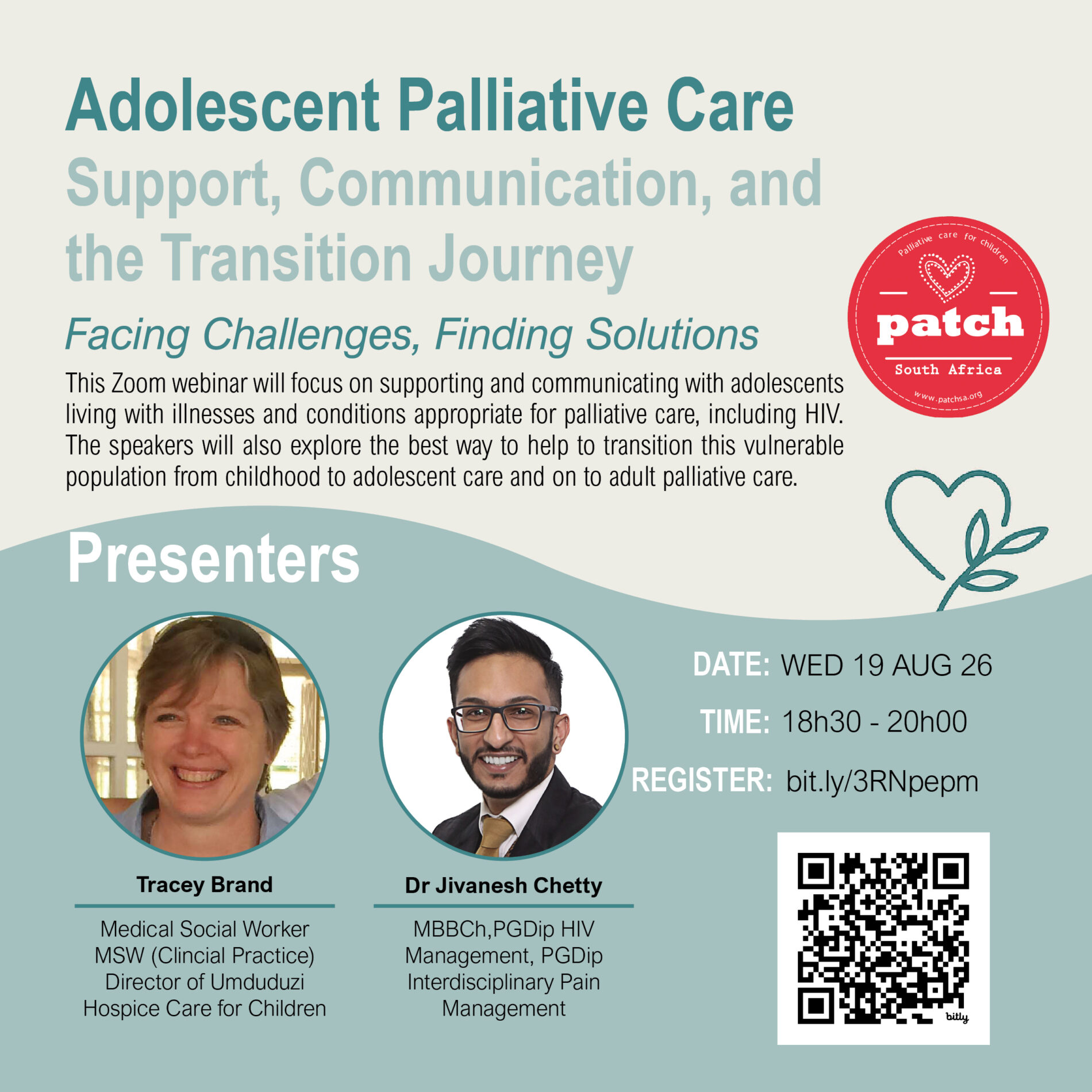
This webinar explores adolescent palliative care, effective communication with young people, and the transition from paediatric to adult palliative care.
Adolescence is a complex stage of development, and for young people living with life-limiting or life-threatening conditions, navigating illness, relationships, independence and changing healthcare needs can bring additional challenges. Providing appropriate adolescent palliative care requires healthcare professionals to understand these unique needs and communicate in ways that respect young people’s developing autonomy and preferences.
In this webinar, Tracy Brand, Medical Social Worker and Director of Umduduzi Hospice Care for Children, and Dr Jivanesh Chetty, MBBCh with postgraduate diplomas in HIV Management and Interdisciplinary Pain Management, explore practical approaches to supporting and communicating with adolescents living with conditions appropriate for palliative care, including HIV.
The webinar examines the transition journey from childhood and paediatric services to adolescent and adult palliative care, highlighting ways healthcare professionals can support continuity of care and help young people and their families navigate this important change.
Assets and References from the webinar
- Transitioning Adolescents with HIV from Paediatric to Adult Care in Rural South Africa – A Palliative Care Perspective Dr Jivanesh Chetty
- Adolescents_PalliativeCare_and_Transition Tracey Brand
- Transition from pediatric to adult are for adolescents living with HIV in South Africa: A natural experiment and survival PLOS One Brian C. Zanoni, Moherndran Archary, Thobekile Sibaya, Nicholas Musinguzi, Jessica E. Haberer
- Transition of adolescents from paediatric to adult HIV care in South Africa: A policy review Southern African Journal of HIV Medicine | Vol 26, No 1 | a1674 | DOI: https://doi.org/10.4102/sajhivmed.v26i1.1674 | © 2025 Charné Petinger, Talitha Crowley, Brian van Wyk
- Qualitative situational analysis of palliative care for adolescents with cancer and HIV in South Africa: healthcare worker perceptions BMJ Journals Nothando Ngwenya, Julia Ambler, Moherndran Archary
- National Consolidated Guidelines for the Prevention and Management of HIV in Adults, Adolescents, Children, Infants and Pregnant & Breastfeeding Women
- Management of Tuberculosis in Children and Adolescents – A Clinical Guideline for the Diagnosis and Treatment of Drug-susceptible TB in Children and Adolescents in South Africa
- HEeADSSS Assessment Tool https://www.starship.org.nz/guidelines/adolescent-consultation/
- Guide to Taking a Sexual History https://www.cdc.gov/sti/hcp/clinical-guidance/taking-a-sexual-history.html
- National Integrated Sexual Reproductive Health and Right Policy 2020 https://knowledgehub.health.gov.za/elibrary/national-integrated-sexual-reproductive-health-and-right-policy-2020
Beyond the Medicine:
The Role of Therapists in Children’s Palliative Care
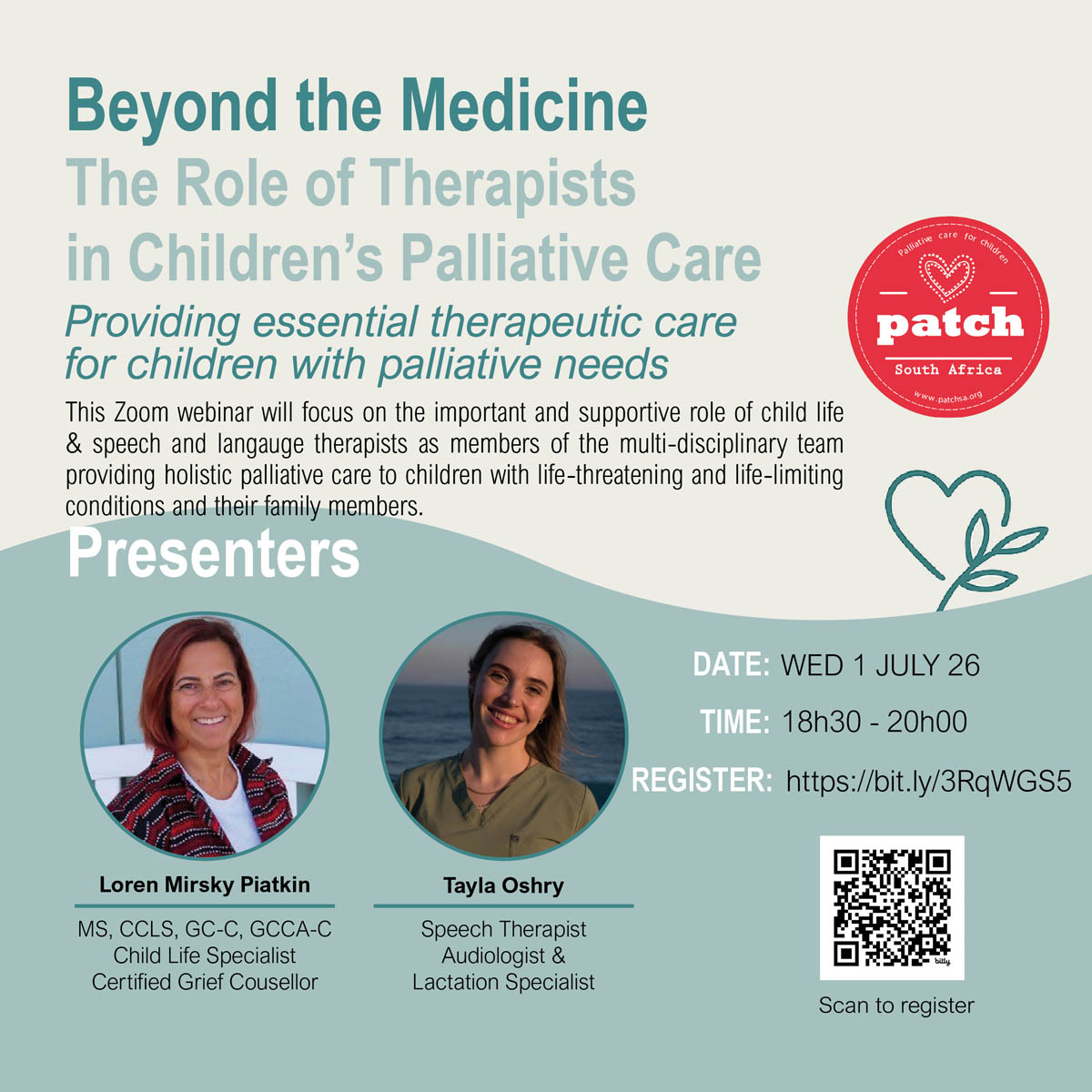
Providing essential therapeutic care for children with palliative care needs
This 90-minute webinar focused on the important and supportive role of non-clinicians such as speech therapists, counsellors, child-life specialists as members of the multi-disciplinary team providing holistic palliative care to children with life-threatening and life-limiting conditions and their family members.
The experienced and highly qualified presenters on this webinar are Loren Mirsky Piatkin, a Child Life Specialist and Certified Grief Counsellor and Tayla Oshrey, a Speech Therapist, Audiologist, and Lactation Specialist.
About the presenters
Loren Mirsky-Piatkin is a Certified Child Life Specialist and Certified Grief Counselor with over 15 years of experience supporting children, patients, and families through some of life’s most challenging moments. Loren is passionate about paediatric palliative care and is dedicated to providing compassionate, holistic support to families navigating serious illness, complex medical journeys, grief, and loss. Through both professional and volunteer work around the world, she specialises in grief support, memory-making, legacy building, sibling support, and advocacy, helping families find connection, meaning, and support throughout their journey.
Tayla Oshry is a Speech Therapist, Audiologist and Lactation Consultant who works at the General Justice Gizenga Mpanza Regional Hospital. She also owns a small practice in Ballito. Tayla has a special interest in Augmentative and Alternative Communication (AAC) and dysphagia in palliative care and has been a speaker at the 2025 Palliative Care Conference and Critical Care Congress. When she’s not at the hospital, you can find her on the beach, traveling, or crocheting with her three cats.
Assets from the webinar
- Presentation on Role of Child Life Specialist on the PPC Team https://patchsa.org/wp-content/uploads/2026/07/Child-Life-Role-on-a-Palliative-Care-Team-Webinar.pdf
Communicating Under Pressure:
Supporting children & families across care settings

Practical communication strategies for emergency & evolving situations
Presenters on this webinar are Dr Caleb Gage, BTEMC, MPhil EM, PhD EM Clinical Advisor – Proficien Programme Manager City of Johannesburg EMS and Prof Jan du Plessis, MBChB, MMed Paed Paediatric Oncologist Universitas Academic Hospital, Bloemfontein
This Zoom webinar has a focus on communicating well in times of urgency and uncertainty, with an emphasis on helping patients and families feel heard, understood, and actively involved in decision making, even when time is limited. The presenters explored how skilled and compassionate communication can support a sense of shared understanding and a ‘dynamic of control’, where patients and families remain partners in care as situations evolve.
Assets from the webinar
- Presentation by Dr Caleb Gage https://patchsa.org/wp-content/uploads/2026/03/The-Posture-of-Meaningful-Communication-Dr-Caleb-Gage.pdf
- Presentation by Prof Jan du Plessis https://patchsa.org/wp-content/uploads/2026/03/Communicating-under-pressure-Prof-Jan-duPlessis.pdf
- Read the research paper The dynamic of control: A qualitative analysis of the perspectives of patients and family members with palliative care needs on Emergency Medical Services (authored by Caleb Gage, Liz Gwyther, and Willem Stassen) https://journals.sagepub.com/doi/10.1177/26323524251409346
- An article on the paper can be found on this site at https://patchsa.org/new-south-african-research-on-ems-and-palliative-care/
- 10 Golden Phrases to Use when a child may die https://patchsa.org/wp-content/uploads/2026/03/Ten-golden-phrases-when-a-child-may-die-1.pdf
- Take the Patch Academy Course: Communication in Children’s Palliative Care
Navigating access to pain & symptom management
for children with rare diseases

In this PatchSA webinar, Kelly du Plessis, CEO of Rare Diseases South Africa talks about the need for palliative care for children with rare diseases. Many rare diseases are life-limiting or life-threatening, and often cause complex physical, emotional, and social challenges for the child and family. Because of this, children with rare diseases frequently need palliative care — not only at the end of life, but from the time of diagnosis and throughout the course of their illness. In South Africa and globally, rare diseases often lead to a palliative care need by default, because access to disease-specific treatment is limited and symptoms can be severe or progressive. Palliative care teams help fill this gap by ensuring comfort, dignity, and holistic care. The video also features a NF (Neurofibromatosis) warrior mom, Lebohang Leuta who speaks about the challenges of having to care for a child with a rare disease.
Seen & Unseen Suffering in Children’s Palliative Care

Assessing Physical & Spiritual Pain in Children’s Palliative Care
In this PatchSA webinar, held on 20 Aug 2025, Dr Michelle Meiring, founder of Paedspal, an expert on children’s pain, and convener of the Post-Graduate Diploma in Paediatric Palliative Care at the University of Cape Town and Sr Joan Marston, founder of Sunflower Children’s Hospice and global expert on and ambassador for palliative care for adults, children, and those in emergency and humanitarian situations, speak about the vital importance of thorough history taking and impeccable assessment of the physical and spiritual suffering of children with palliative care needs.
Download the presentations as PDFs
Assessing Seen and Unseen Physical Pain in Children – Dr Michelle Meiring
Assessing Spiritual Suffering in Children – Sr Joan Marston
Withholding & Withdrawing of Treatment in Perinatal Palliative Care

Withholding and withdrawing of treatment in perinatal palliative care
A webinar hosted by PatchSA on Wednesday 10 September 2025 in which Dr Julia Ambler, Medical Director of Umduduzi Hospice Care for Children, gives valuable insight into the ethics and decision-making process with regard to withholding and withdrawing treatment when a baby is receiving perinatal palliative care. Throughout the webinar she emphasises the need for open and honest communication, including deep listening, with the parents and with professional colleagues and talks about the need for being respectful when opinions may differ.